



Passion & Control in Shakespeare’s
Twelfth Night
By Ann Richards and Carol McCluer
♦
In The Right of Aesthetic Realism to Be Known #212, titled “All the Arts,” Eli Siegel writes:
Feeling and craft are the greatest friends in all the arts; and these correspond to passion and control… Every art asks care from the person working in the art; and every art also asks for adequate feeling or passion.
We’re studying how acting has these opposites again and again; and Aesthetic Realism is teaching us this new idea: that the answers to the questions people have everywhere daily are in the structure of the art we love.“ What should I be passionate about, if anything?” “Am I too cold, do I have enough feeling?” and “Why do I feel I’m all over the place, and don’t have control of my emotions?” are questions that torment women and men all over the world.
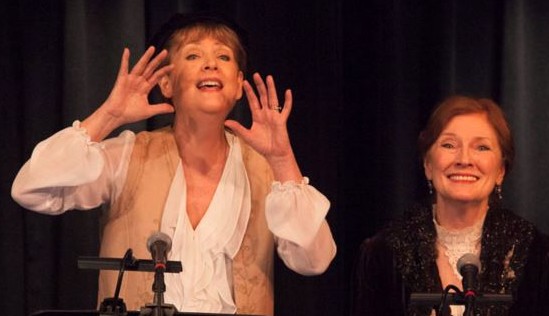
We studied a scene from Shakespeare’s Twelfth Night, or What You Will; and through a lecture Eli Siegel gave on this play, we learned about ourselves and other people as we looked at two women—Viola and Olivia. We had the thrill of seeing how opposites in the drama tell us about ourselves.
Twelfth Night has been called Shakespeare’s Farewell to Comedy and was written about 1600. It is wild and subtle, surprising and right, passionate and controlled. The story involves three sets of characters who intermingle as in a mad, strange, happy dance.
In his lecture on the play, Eli Siegel said:
This play can be said to be a lot about self-love trying to be love.
There is Orsino, Duke of Illyria who thinks he is in love with Olivia. Olivia has shut her doors on society. She is in a self-proclaimed seven-year mourning over her brother’s death. Then there is Viola. She has been shipwrecked on the shores of Illyria—where all this takes place, by the way—and she is disguised as a boy named Cesario. She falls in love with Orsino; but not knowing she is a woman, Orsino engages Viola as his page, and sends her to woo Olivia for him. What a situation! There is enough feeling in all these people to make one dizzy; but Shakespeare controls it all.
The scene we are studying is Act I, Scene V, in which Viola, as Cesario, the boy page, is to deliver Orsino’s declaration of love to Olivia. The scene is an intricate mingling of passion and control. Viola is controlling her own passion for Orsino, and hiding her true identity. Olivia’s passion is all for herself; she is in a fight between boredom and interest, a bad kind of control and passion.
Olivia is dressed in black, with a veil over her head. She speaks about her body as though it were separate from herself. She shows how intensely a person can feel this world does not deserve her passion; and her control is really contempt:
Viola. Good madam, let me see your face.
Olivia. Look you, sir. Such a one I was this present.

I, Ann Richards, have been studying the Olivia tendency in myself since my first Aesthetic Realism consultation, to which I wore black. I said my emotions had control over me: I did not have control over them. My consultants asked me: “What is the emotion that you are most against? I said, “I get very sad. I can cry at the drop of a hat.” And they asked, “Do you in any way treasure your sadness? Do you think it’s charming? Do you think it makes you more sensitive than other people?”
Aesthetic Realism consultations teach a person how opposites can be in a beautiful relation in life. Hearing Aesthetic Realism criticism has enabled me to see where I was largely the source of my own pain and, to my amazement, I have been able to laugh at myself. My gratitude to Eli Siegel and my consultants for the changes in my life grows every day.
In the lecture on Twelfth Night, Mr. Siegel says of Viola:
Viola represents energy; energy likewise with gentleness.
Energy with gentleness is another way of saying passionate and controlled. Mr. Siegel continues:
Viola represents the outside world coming from the water to stir up both Orsino and Olivia. She represents that third something.
I, Carol McCluer, love the character of Viola and feel it is an honor to try to give form to her. She stands for the world as criticism and encouragement. It is she, disguised as the young man, Cesario, who criticizes Olivia’s containment and bad control; she tells it to her straight, and for the first time, Olivia feels really loved.
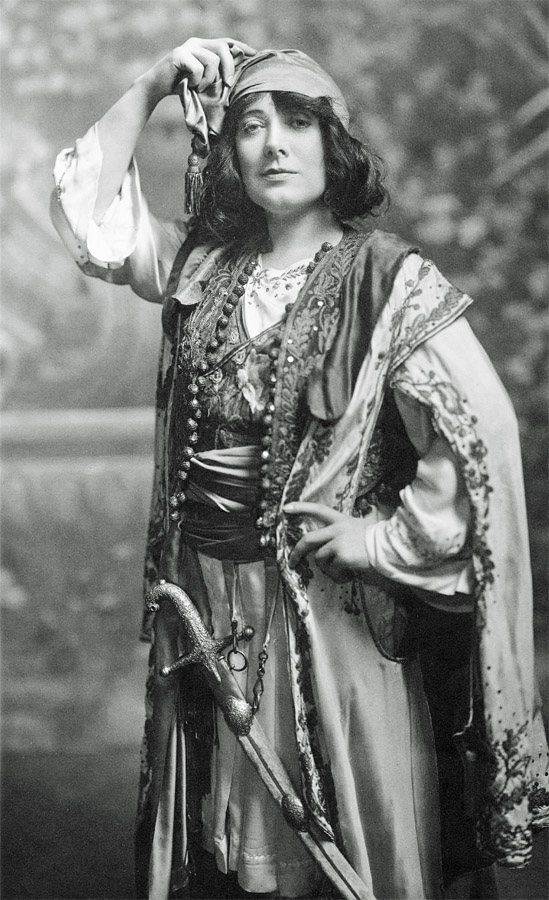
An actress known for her portrayal of Viola is Julia Marlowe, of early 20th century America. She was also known for her portrayal of Rosalind, another Shakespearean heroine who disguises herself as a boy in order to both hide and show her passion. Reading a biography of her and reviews of her performances has had a large effect on my study of the character. I think her interpretation of Viola as deeply feminine, yet more of an idea than a human being of flesh and blood, has affected actresses since then; and I know Julia Marlowe would have loved what Eli Siegel said about this role: “Shakespeare uses people as ideas and ideas as people.”
Even though Orsino, whom Viola loves, has sent her to woo Olivia for him, Viola does not have ill will for Olivia. Instead, she feels passionately that if Olivia is the woman who can strengthen Orsino, that should be. Viola pities the weakness in Olivia and criticizes her roundly. She says, “I see you what you are; you are too proud.” She also sees a beautiful possibility in Olivia which affects Olivia deeply, but not in the way Viola expected. The fact is, Olivia falls in love with Viola! Mr. Siegel explains the sudden passion of Olivia, when he says:
If one thinks that the first time Olivia sees Viola she’s going to be so moved that she has to send after Viola and do this business with the ring—of course, that’s unbelievable. Ibsen would never do it. It’s unbelievable. But if you see Viola as a sudden idea, a sudden awareness, then it is beautiful, like a sudden change of music.
In Viola, Olivia sees a world worth her passion.
It is Viola whom Eli Siegel quotes in his essay The Ordinary Doom as showing the desire in people to be hidden and not known. Viola is beautiful because she comes to see this hiddenness as a mistake, and later in the play, she says: “Disguise, I see thou art a wickedness.” The trouble in my life has been that most of the time I felt, “Disguise, thou art wonderful!” I was asked kind and critical questions in my first consultation, such as: “Do you think you have a question about how much you want to show yourself as such?”
Carol McCluer. Yes.
Consultants. You smile. Do you also cry? Are your smiles and tears in the same world or different?
CMc. Different.
Consultants. Do you feel you’ve fooled people?
CMc. Yes.
Through studying Aesthetic Realism, we’ve been able to change. In The Right Of #212, Mr. Siegel writes:
Every person, too, is a constant mingling of life unshaped and of life possibly shaped. A person is an art problem, cherished and a little feared by himself.
We love studying acting from the Aesthetic Realism point of view, and learning about the relation of drama to life.